Skip to content

Construction hoist hire

We lift building materials to height for builders and roofers: steel beams to a top-floor scaffold, roofing materials to a flat roof, boards and blocks to a new build. A lift takes less than a minute, and waste can come back down the same way.

Our three goods hoists are hired by the hour, for a block of hours or by the day, not for months. The truck-mounted hoist reaches 27 metres; the trailer hoist and the 240v rail hoist reach 18 metres and fit where a truck can’t.

  • Up to 27 m
  • 250–400 kg
  • Always with our operator

Five stars from our Google reviews

“Short notice booking taken and arrived promptly. Totally professional from start to finish…”

Tom Sullivan, Google review
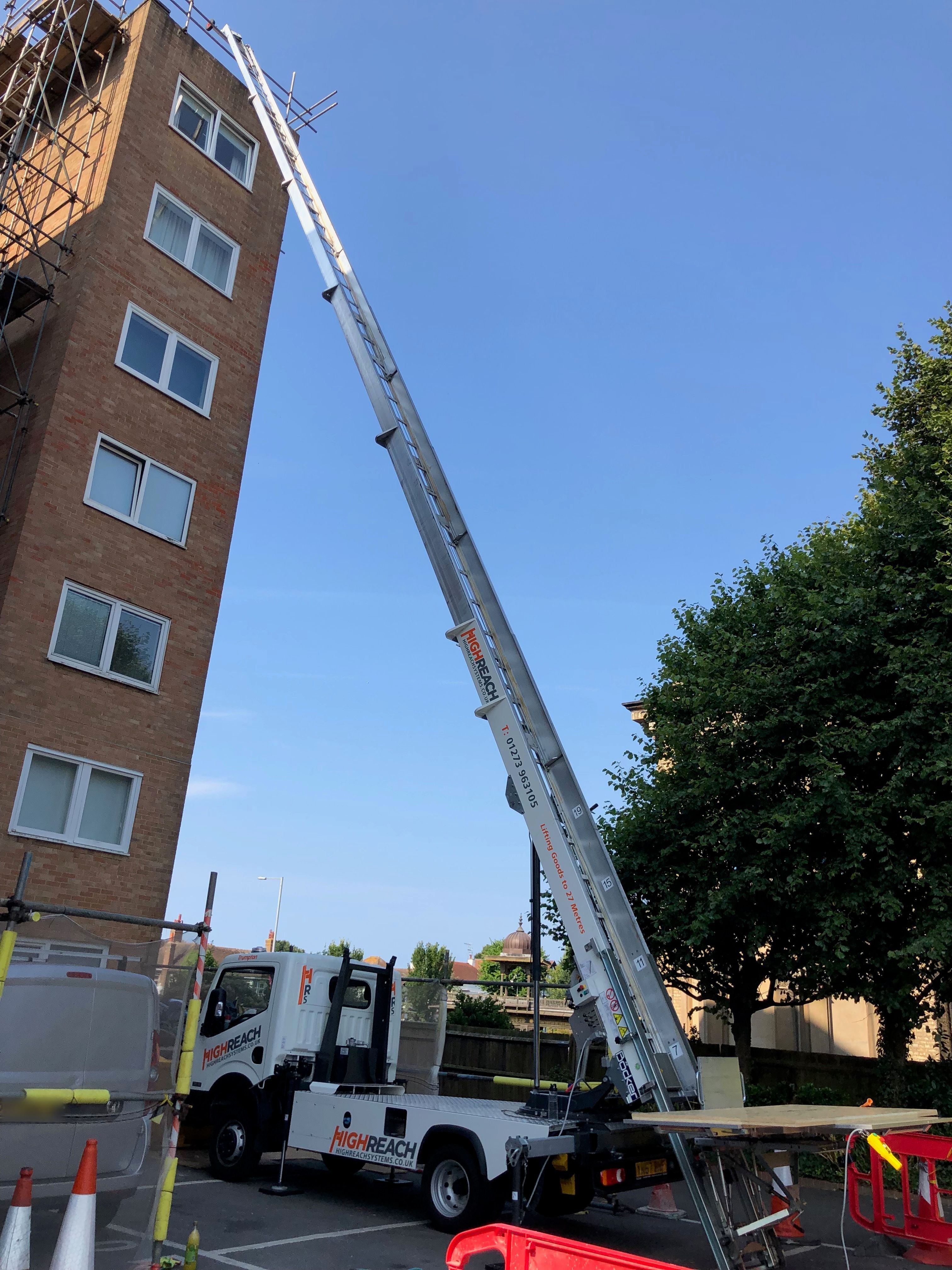
High Reach truck-mounted hoist with its ladder near full extension, reaching the roof of a seven-storey brick block of flats, barriers round the truck

Which kind of construction hoist?

“Construction hoist” covers several quite different machines, and it helps to know which one a job needs before you ask for prices.

On large sites it usually means a rack-and-pinion hoist: an enclosed car that climbs a mast tied into the building, carrying people as well as materials. It stays for the length of the build. A scaffold hoist is much smaller, an electric winch fixed to the scaffold that lifts loads on a rope. We hire neither.

What we hire are mobile goods hoists, also called material hoists or builders’ hoists. A platform runs up a ladder or rail set at an angle against the building, carries the load to the level you need and comes back down. They come on the day, do the lifting and leave. That suits loft conversions, extensions, re-roofs and deliveries to a roof or an upper floor, where hiring a crane or a fixed hoist for the duration doesn’t make financial sense.

They carry materials, not people.

Types of construction hoist, and which ones High Reach hires
TypeHow it worksLiftsFrom us?
Rack-and-pinion hoistAn enclosed car climbs a mast tied into the building.People and materials on large sites, for the length of the build.No
Scaffold hoistAn electric winch fixed to the scaffold lifts loads on a rope.Light loads to a scaffold lift.No
Truck-mounted goods hoistA platform runs up a telescopic ladder raised from a small truck.300–400 kg to 27 m, where the truck can park close to the building.Yes, with our operator
Trailer hoistA towed trailer with a boom that swivels through 360°.250 kg to 18 m, where a truck can’t get in.Yes, the Paus 18 WH, with our operator
Ladder or rail hoistA platform runs up an aluminium rail bolted together on site.250 kg to 18 m in small spaces.Yes, with our operator

Our three hoists on site

We started out lifting furniture, and builders soon began calling. The truck-mounted hoist has done most of that work since, from steel beams and roofing sheets to boards and blocks for a new build. It parks in a yard, a car park or on the road; on one job it stood on a gravel garden path.

The trailer hoist goes where the truck can’t: we have set it up in a rear car park in Camden and on a grass verge in Shoreham. The 240v rail hoist is bolted together on site in sections, so it fits the smallest spaces; our ladder hoist page has the detail.

Truck-mounted hoist

External furniture elevator on a transit-size truck

Lifting height
3–27 m
Safe working load
300–400 kg

Maximum load 400 kg, depending on height.

Platform
2700 × 1465 mm, flat or as a box; rotates 360°
Set-up
Installed in 15 minutes
Footprint
A transit-size truck, not a crane. We recommend two parking bays below the window or balcony
Carriage speed
Up to 60 m a minute
Power
The truck’s own engine, through a power take-off (PTO)
Hire
By the hour, for a block of hours or by the day
Operator
Always supplied with a trained operator
Trailer hoist

Paus 18 WH

Lifting height
3–18 m
Safe working load
250 kg
Size on the road
5100 × 1400 mm (length × width)
Axle width
1.3 m, so it fits through narrow gaps
Boom
4.45 m to about 17.3 m, swivelling 360°
Power
240v supply, from a standard 3-pin plug
Hire
By the hour, for a block of hours or by the day
Operator
Always supplied with our operator

240v demountable hoist

Aluminium rail hoist

Lifting height
3–18 m
Safe working load
250 kg
Set-up
Aluminium rails bolted together on site
Footprint
Made up of sections, so it fits small spaces; stands on most surfaces, including grass
Power
240v supply, from a standard 3-pin plug
Hire
By the hour, for a block of hours or by the day
Operator
Always supplied with our operator

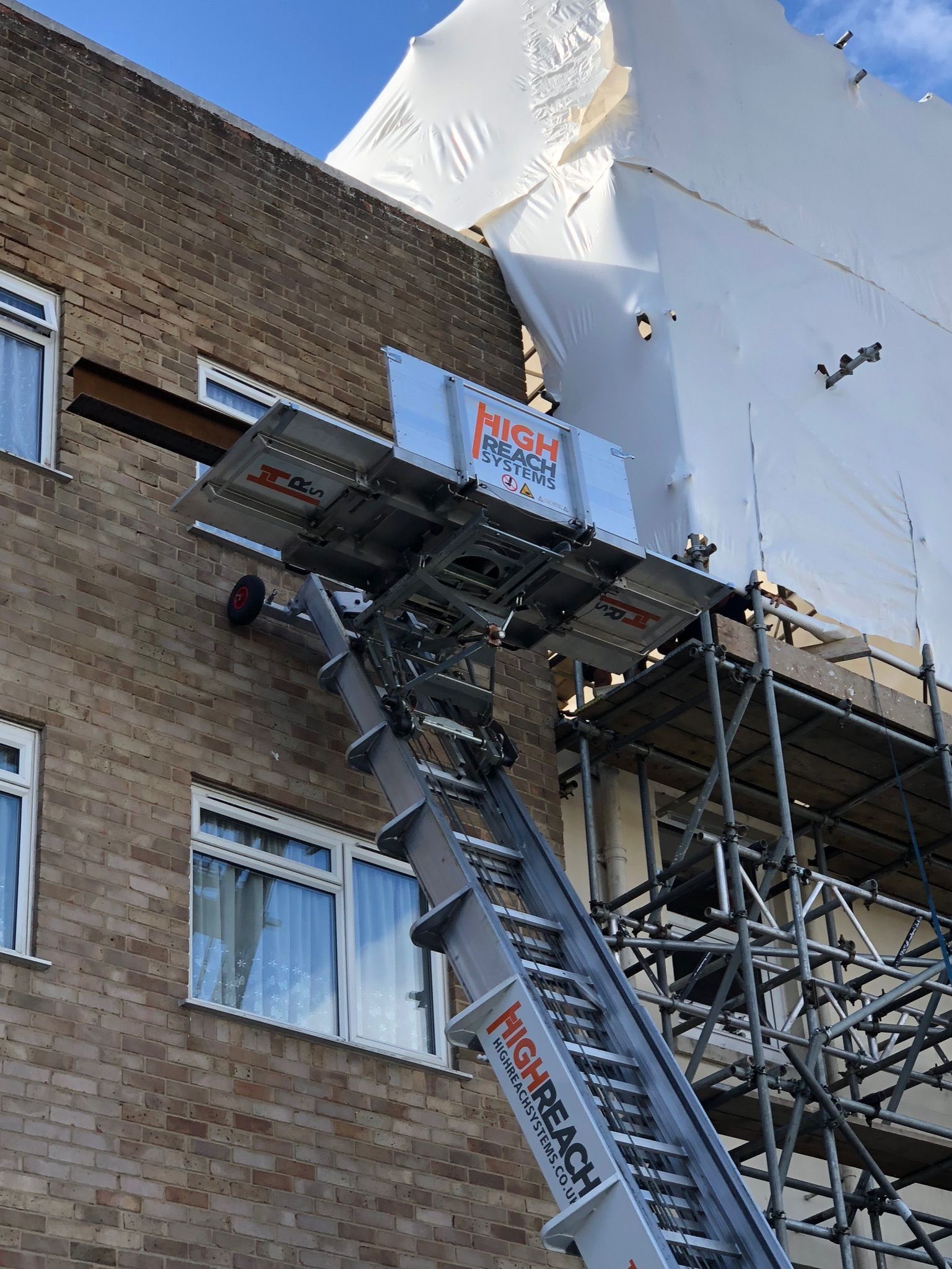
Steel beams in under a minute each

Truck-mounted hoist platform carrying a steel beam up to the scaffold of a terraced house in Brighton and Hove, beside a brick block of flats
A beam arriving at the scaffold, beside the temporary roof.

Brighton and Hove · August 2018 · Third (top) floor · Truck-mounted hoist

Four steel beams to a top-floor scaffold

What we lifted
Four RSJs of 120 kg each, for a development on the top floor of a terraced house under a temporary roof.
The access
The scaffold was at the back of the building, where the truck couldn’t go. Carrying the steel up by hand would have taken the builders a few hours, with a risk of injury and of damage inside and out.
How it was done
We parked in the car park of the neighbouring block, a few metres away, and rested the head of the ladder on its wall. The platform was raised to the exact height of the scaffold boards, within inches of them, and the builders slid each beam off onto the scaffold.
How long it took
Under a minute a beam, and no more than 30 minutes for the whole job.
One of the four beams going up, filmed from the neighbouring car park. 26 seconds, no sound.

One beam, start to finish

The platform climbs the ladder with the beam across it and stops level with the scaffold. The winch starts and stops softly, and small, precise adjustments bring the platform to the exact height of the boards.

“This was the first time we had used an external hoisting company for this job and we couldn’t believe how quick and efficient High Reach Systems were. We will definitely use them again in the future and will be recommending them within the industry.”

The building contractor, after the job

Two more site jobs

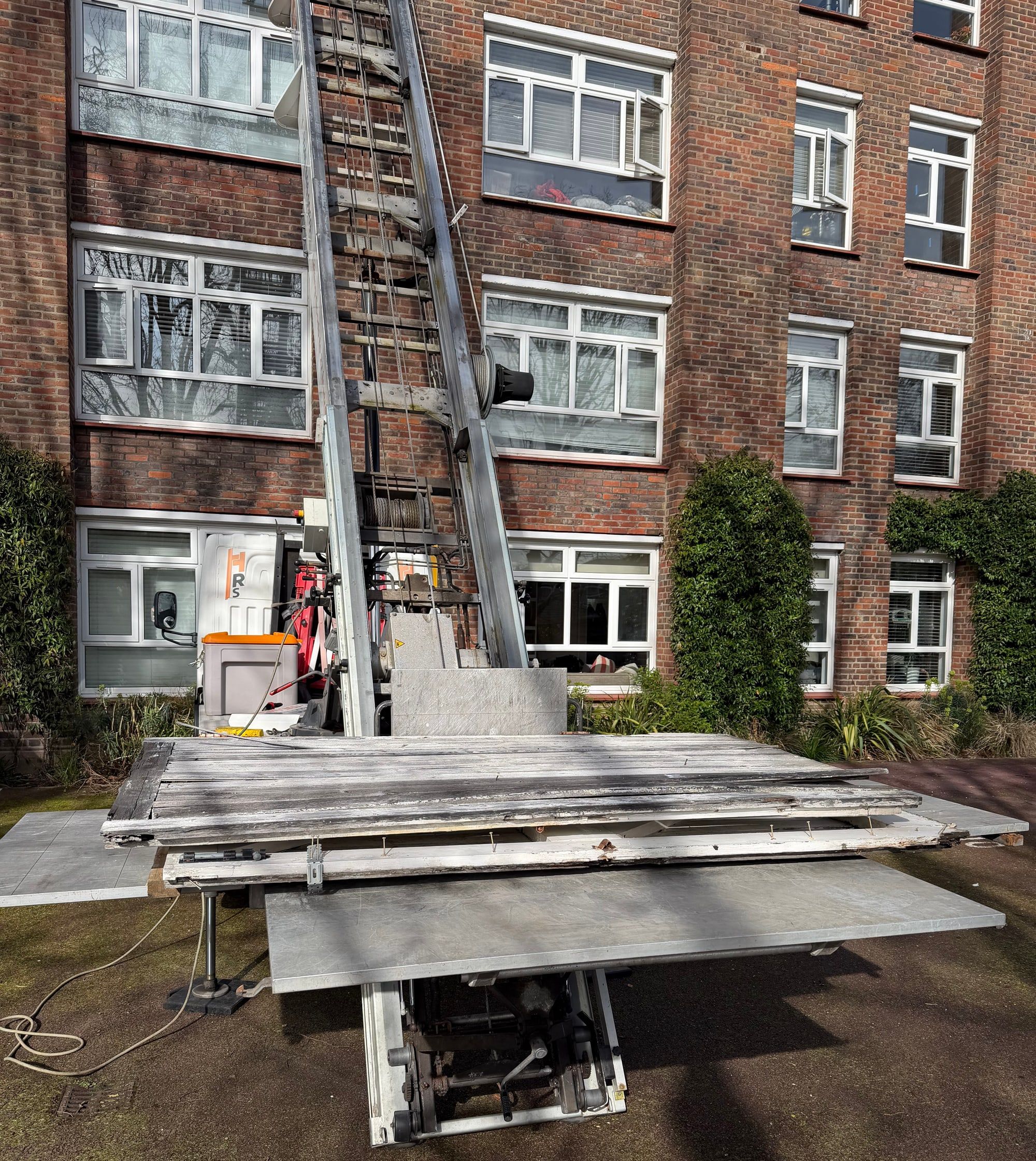
Truck-mounted hoist platform at ground level in front of a four-storey brick block in Blackheath, loaded with weathered old timber boards, the ladder rising up the front of the block behind it

Blackheath, London · March 2026 · Roof

From the forecourt to the roof

We parked on the forecourt in front of a four-storey brick block and ran the platform up to the roof edge. The loads included weathered old timber with the nails still in it.

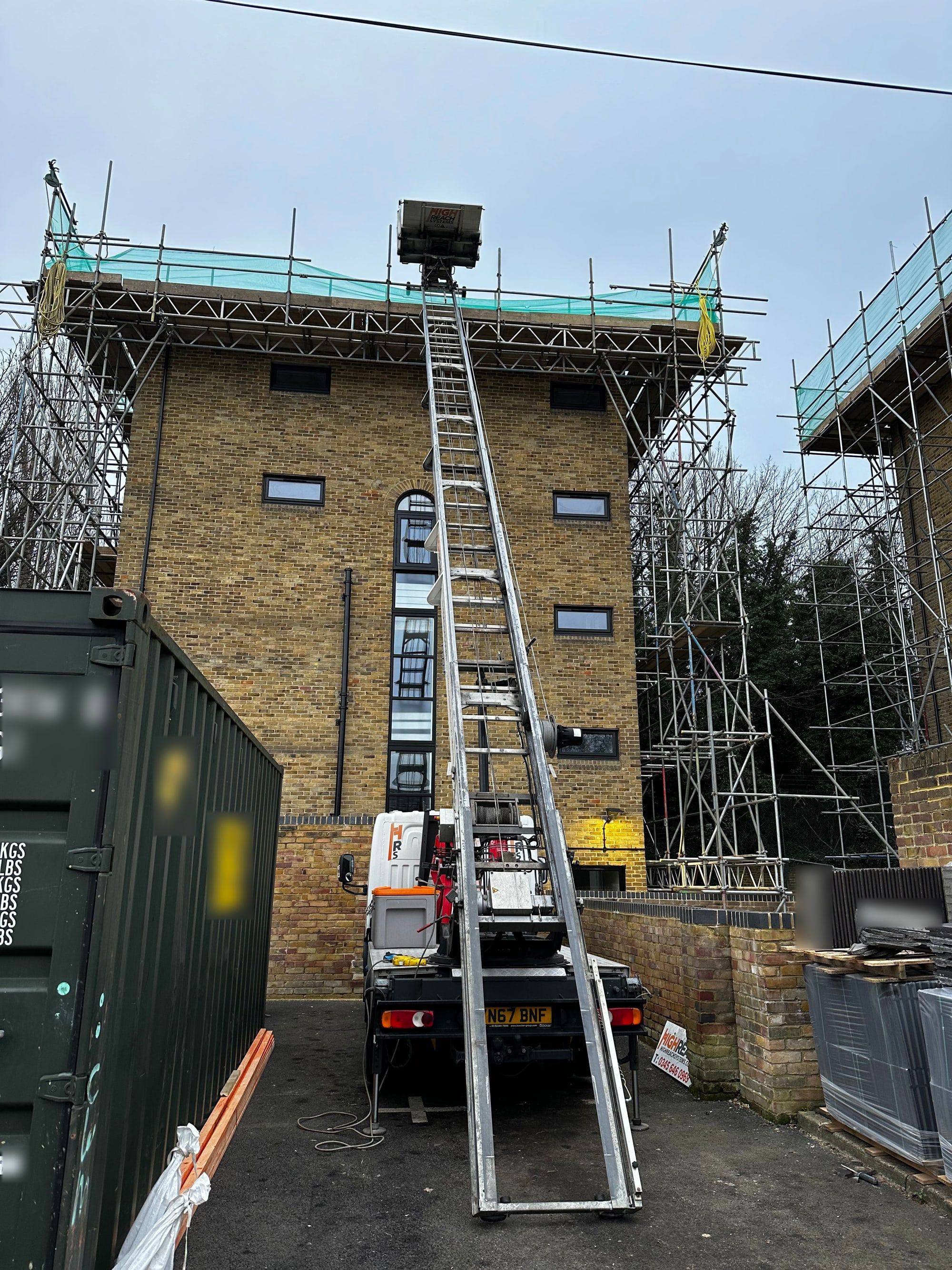
High Reach truck-mounted hoist parked between a site container and a brick wall, its ladder straight up to the netted roof scaffold of a yellow-brick block in Gillingham, the platform at the top

Gillingham, Kent · January 2024 · Roof scaffold

One roof scaffold, three parking spots

At a five-storey yellow-brick block under scaffold, we set up in the road, then in the car park, then beside a site container, all in one week. Each time we ran the ladder up to the roof scaffold.

What goes up, and what comes down

We have found a way to lift most things a builder needs at height. Loads go up to 250 kg a lift on the trailer and rail hoists and up to 400 kg on the truck, depending on height. Items longer than the truck’s 2700 mm platform can travel if they are secured.

  • Steel beams (RSJs)
  • OSB boards and concrete blocks
  • Profiled metal roofing sheets
  • Roofing materials for flat roofs
  • Roof tiles, flooring and insulation
  • Scaffold poles and planks
  • Bathroom suites and fitted kitchens
  • A glazed rooflight for a loft conversion
  • Large wrapped units, to a roof
  • Machinery and masonry
  • Builders’ waste, lowered back down
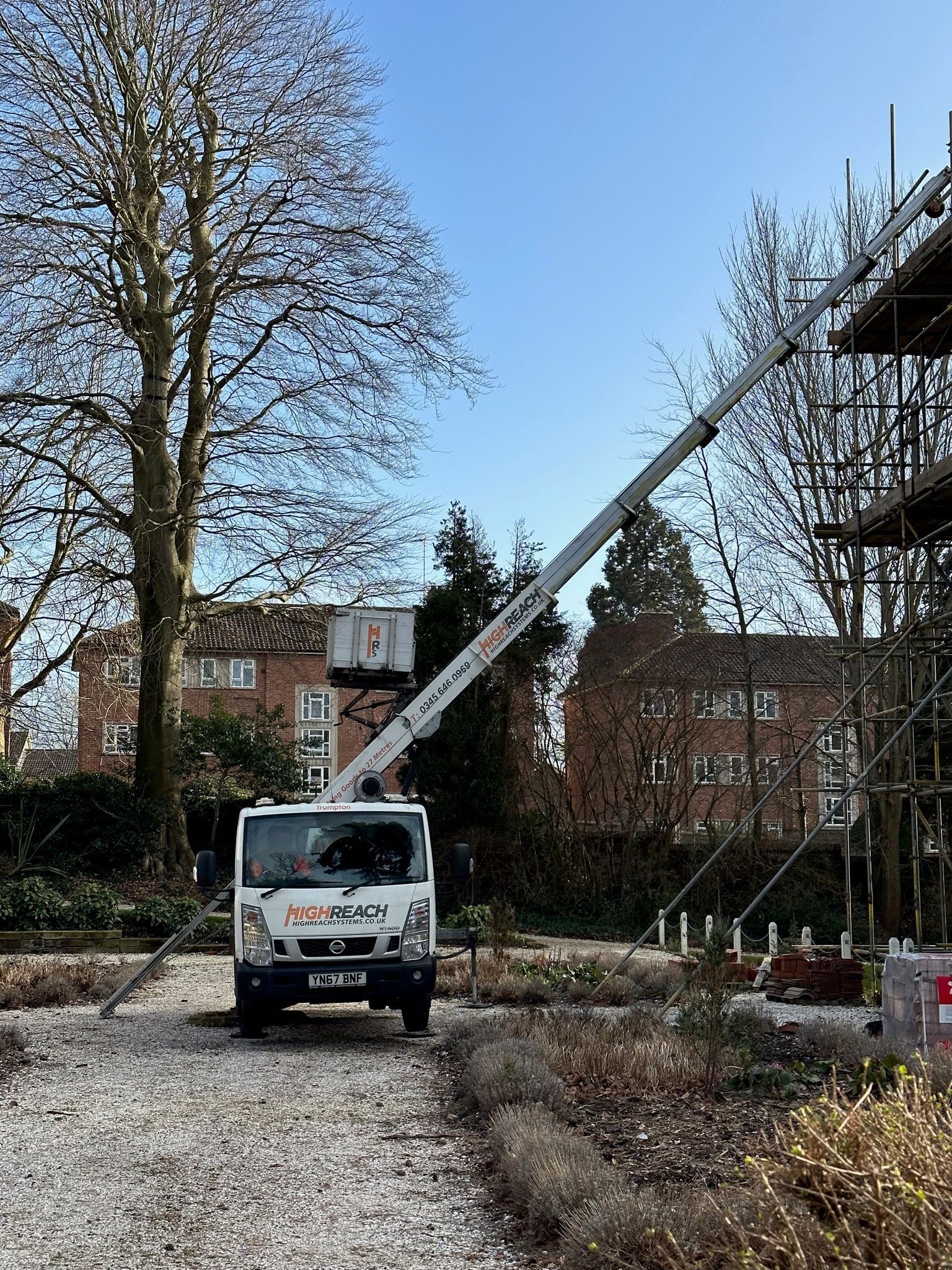
High Reach truck-mounted hoist parked on a gravel garden path, its ladder up to the roof scaffold of a 1930s block of flats in Hove
Roof scaffold on a 1930s block of flats in Hove, March 2023. The truck stood on a gravel garden path.

What you arrange, and what we bring

A clear, stable base

The truck needs a clear, stable area directly below and in line with where the load is going. The trailer and rail hoists fit tighter spots, and the rail hoist stands on most surfaces, including grass.

Permission to park

Where the hoist stands in a restricted area, the hirer arranges the permission: a dispensation, a suspension or a partial road closure. Tell the council it is an elevator on a transit-size truck, not a crane.

Loading and unloading

Your team loads the platform at the bottom and unloads it at the top. Our operator checks that each load is within the safe working load and can refuse one that isn’t safe to travel.

IPAF-qualified operators

All our operatives are fully factory trained and IPAF qualified, and every hoist comes with one of them.

£25 million cover

We carry public liability insurance cover to the value of £25 million.

LOLER

Lifting equipment must be thoroughly examined under LOLER, the Lifting Operations and Lifting Equipment Regulations 1998. Ask to see the hoist’s current report when you book.

If you are unsure about the access or where the hoist should stand, we can visit first (charges may apply). A full charge applies if the hoist can’t be used once it is on site.

What customers say about working with us

Five stars

From our Google reviews

A reliable efficient no hassle contractor. … He arrived punctually, made no fuss, had a great helpful can-do attitude, worked well with my contractors. The job was done quickly and efficiently with expertise and care…

RyN1, Google review

Dear Simon, Thank you for a great and super fast service lifting up artificial grass to our roof top project in London, especially accepting and organising the job with such a short notice . Highly recommended.

Adam Rutecki

Google review

Questions builders ask

All FAQs
Can I hire the 240v demountable hoist myself?

No. Like every hoist, it comes with one of our operators. We don’t offer self-hire.

As with all our hoists, you can hire it by the hour, for a block of hours or by the day. It runs off a standard 240v 3-pin plug.

Can you lift the tiles onto the roof for a re-roof?

Yes. Roof tiles go up in loads within the safe working load: 250 kg a lift on the rail and trailer hoists, and up to 400 kg on the truck-mounted hoist, depending on height.

Tell us the roof height, roughly how many tiles and where a hoist can stand. Any of our hoists can be hired by the hour, for a block of hours or by the day, and for more than one day if the lifting needs it. Each comes with our operator.

Can you lift decking timber 3.2 to 4.2 metres long?

Usually, yes. The truck-mounted hoist’s platform is 2700 × 1465 mm, but longer items can travel as long as the load is secure, and its sides fold down to make a channel for long lengths.

Tell us the lengths, the total weight and where they need to go.

We need about 200 steel panels on a flat roof 20 metres up. Can a hoist do it?

The truck-mounted hoist reaches 27 metres, so 20 metres is within range, and it takes up to 400 kg a lift, depending on height. The panels go up in as many lifts as their weight needs, with your team unloading at the roof.

We have lifted roofers’ materials to flat roofs before, for example on a five-storey block in Lambeth. Send us the panels’ size and weight for a quote.

Can you take waste down as well?

Yes. What goes up can come down: builders’ waste can be lowered on the platform rather than carried down through the building, which keeps debris out of the communal areas.

Can you lift an air-conditioning unit onto a roof?

Yes, if a hoist can stand close enough to the building. A condenser of 50 to 70 kg is well within the safe working load of all three hoists.

How quickly does the hoist set up?

The truck-mounted hoist is installed in about 15 minutes once the truck is parked. Ask us how long the trailer hoist or the rail hoist will take on your site, as it depends on the access.

How much does construction hoist hire cost?

We quote each job rather than publish prices. The quote depends on the hoist, the height, the weight and number of lifts, the access and parking, and how long you need it.

Send us the address, what needs lifting and how high, ideally with a photo of the site.

Get in touch

Get a quote today

Tell us the address, what needs lifting, how heavy it is and how high it has to go. A photo of the site helps us suggest the right hoist.